Case Study
18 Certificates of Sponsorship in 7 Days: How We Helped Avida Supported Living Secure Their Workforce
By Sponsor ComplIANS · 11 April 2026 · 14 min read
What Is an Undefined Certificate of Sponsorship (UCoS)?
An undefined Certificate of Sponsorship is a CoS that a licensed sponsor requests from the Home Office before it can be assigned to a specific worker. Unlike defined CoS — which are used for workers applying from outside the UK — undefined CoS are allocated to sponsors for workers who are already in the UK and switching visa routes or extending their stay. The Home Office must approve the allocation before the sponsor can assign the CoS and the worker can submit their visa application.
For care providers relying on sponsored workers, a delayed or refused UCoS allocation can mean workers lose their right to work, care hours go undelivered, and the entire business is placed at risk.
---
How Long Had Avida Been Waiting for Their CoS Allocation?
Avida Supported Living — a supported living company in the West Midlands delivering over 1,300 commissioned care hours per week to 17 vulnerable adults — had applied for 18 undefined Certificates of Sponsorship months earlier. Since the first week of March, Lydia Johnson, the company's director, had been sending daily priority requests to the Home Office. Every single morning before 7am. Not one reply. Not even an acknowledgement.
After three months of silence, the Home Office finally responded — not with an allocation, but with a Further Information Request. Twelve questions, each demanding documentary evidence to justify why the company needed migrant workers. And two of their sponsored workers had visas expiring in less than a fortnight.
That is when Lydia contacted Sponsor ComplIANS.
"Before engaging with Sponsor ComplIANS, we were in a very difficult and uncertain position. We had serious concerns about our sponsor licence compliance and were unsure whether our internal processes were meeting the Home Office's expectations. There was a real risk that our licence could be revoked, which would have had devastating consequences — not only for the organisation but for our sponsored workers and the vulnerable adults we support."
> — Lydia Johnson, Director, Avida Supported Living
---
What Compliance Issues Were Hiding in Avida's Records?
The first afternoon was intense. We started pulling apart Avida's files around 2pm and did not stop until gone 9 that night. Employment contracts, payslips, Right to Work checks, the audit spreadsheet, their Sponsorship Management System records. Everything.
Avida was well-intentioned. They cared about their workers and their service users. But their documentation had serious gaps that they did not know about. As Lydia told us: "The biggest challenge was the lack of clarity and confidence in our compliance processes. We weren't sure if our record-keeping, reporting duties, and HR procedures were fully aligned with Home Office requirements."
None of it was deliberate. It was the kind of thing that builds up when you are running a care company and immigration compliance is not your day job. But collectively, if the Home Office had seen these documents as they were, the allocation would almost certainly have been refused — and there is a real chance it would have triggered something much worse.
Lydia was clear about what was at stake. Without intervention, Avida faced the sponsor licence being revoked, the business being at risk of closure, sponsored workers losing their right to work and having to leave the UK, and having to reduce or close services for vulnerable adults.
---
How Did Sponsor ComplIANS Respond to the Further Information Request?
We did not just write a letter. We had to fix the foundations first.
Before drafting a single word of the response, we conducted a full compliance review of the provider's records. Where documentation did not meet the standard the Home Office expects, we worked with the client to bring everything into line. By the time we submitted, every file in the evidence pack was accurate, consistent, and ready for scrutiny.
We also made strategic decisions about what to include and what to leave out. Not every worker's situation strengthened the application equally. Where the supporting evidence was incomplete or likely to raise more questions than it answered, we adjusted the scope of the request. The goal was a clean, defensible submission — not a comprehensive one.
Then we built the actual response. The Home Office is not reading your letter the way a normal person reads a letter. They are ticking boxes. They are cross-referencing documents. They are looking for inconsistencies. And they are forming a view — not just of the application, but of you as a sponsor.
So we gave them numbers. Real ones. The company was commissioned to deliver over 1,380 hours of care per week to 17 service users. Their current workforce could cover 964 hours. That is a shortfall of more than 400 hours every single week, even with overtime. Thirteen workers had visas expiring within the year. Two were expiring in days.
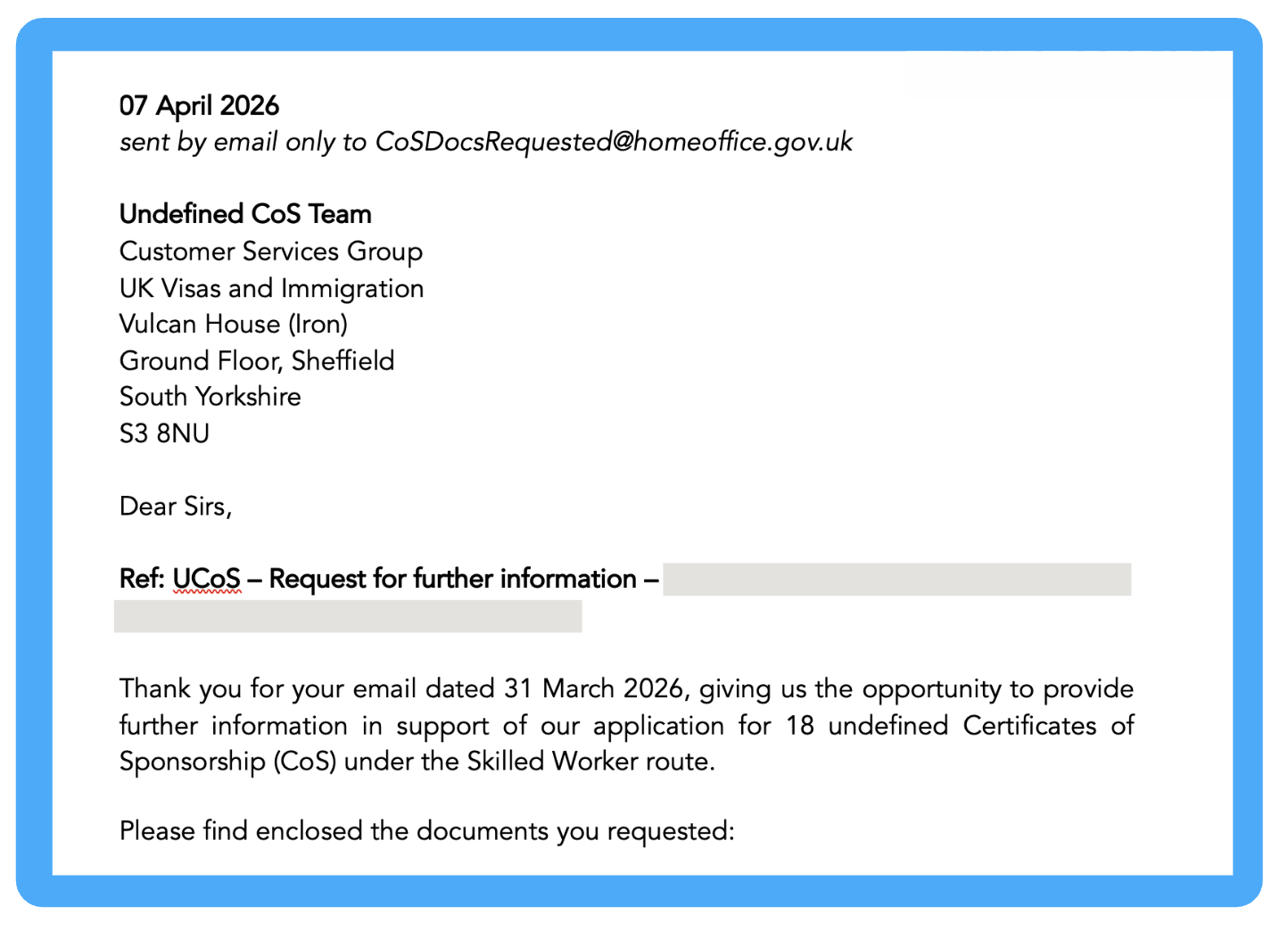
We answered every one of the Home Office's 12 questions. Each answer pointed to specific documents in the evidence pack: signed contracts, three months of payslips, six months of bank statements, staff rotas, service user hours, the council commissioning contract, job descriptions, an org chart, and Right to Work checks. Four emails' worth of attachments, structured so the caseworker could find exactly what they needed without having to dig.
!Our structured response letter to the Undefined CoS Team, dated 7 April 2026
---
What Strategic Decisions Made the Difference?
A strong response to the Home Office is not just about what you include. It is about knowing what to leave out. Every piece of information you volunteer becomes something the caseworker can question. We structured the submission so that it answered exactly what was asked — thoroughly, precisely, and without opening doors to further enquiry.
We also understood that urgency matters. When workers have visas expiring in days, the response needs to communicate that clearly and early. We made sure the caseworker understood the human impact of any delay before they reached the first substantive answer.
What most providers do not realise is that responding to the Home Office is not just about knowing the answers — it is about getting the evidence pack across the line. Many care providers we work with have never had to compile a submission at this level before. The internal team is already stretched. The director is running a care service, not a compliance operation.
That is where we step in. We do not just advise from a distance. We take ownership of the submission process end to end — from evidence gathering to final quality checks — so the provider can focus on what they do best: delivering care. For this client, that meant the difference between a response that stalled and one that landed.
---
What Was the Outcome?
We submitted on a Tuesday.
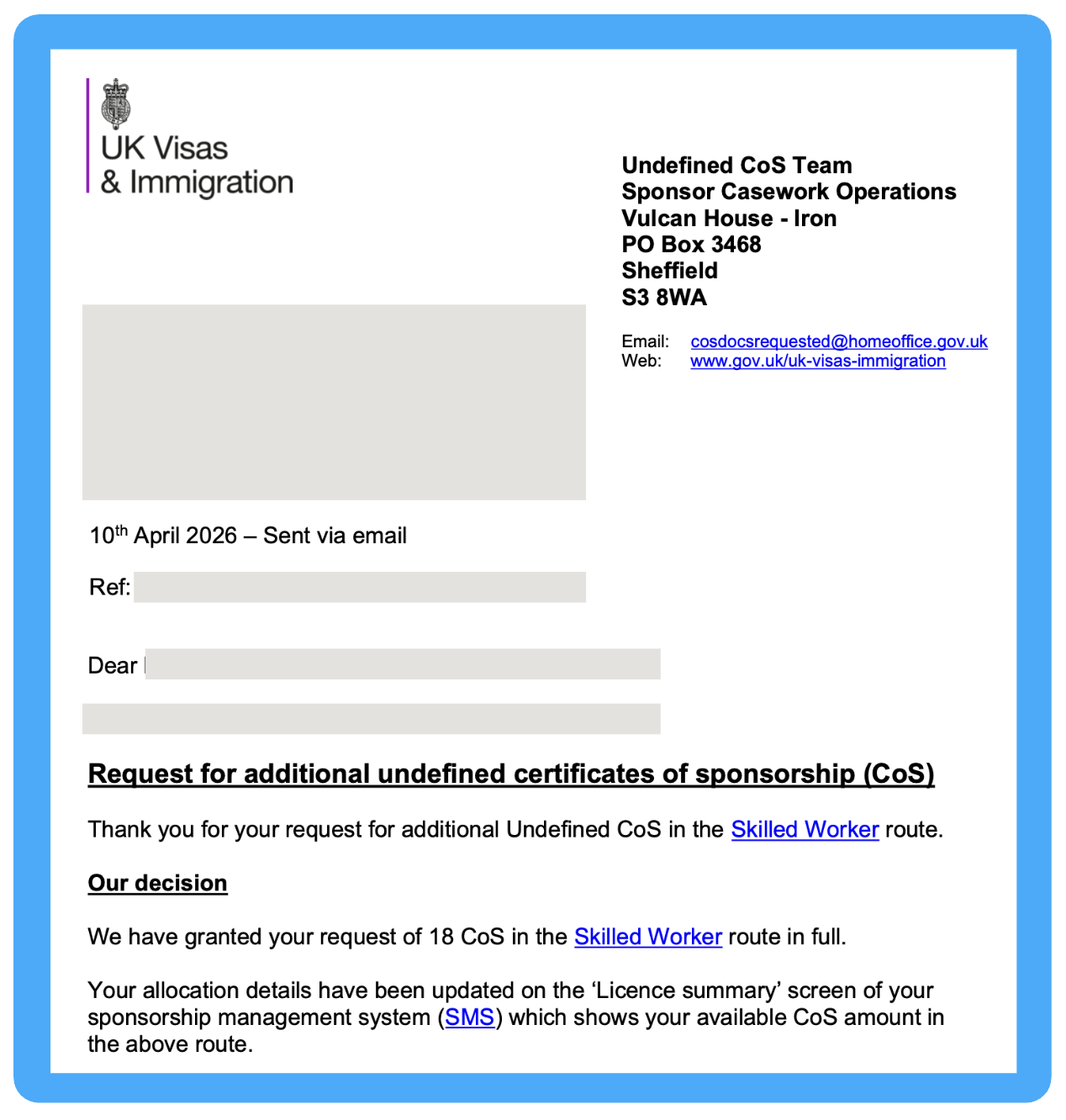
On Thursday — two days later — the Home Office granted all 18 Certificates of Sponsorship. In full. No reduction, no conditions, no follow-up questions.
The two workers with expiring visas had their CoS allocated with four days to spare.
When Lydia sent us the approval letter, the reaction across Avida was immediate:
"The moment we received confirmation that all 18 CoS had been granted, there was an overwhelming sense of relief and joy across the entire team. It felt like a huge weight had been lifted. For us, it wasn't just about the paperwork — it was about knowing that our workers were safe, our services could continue, and the people we support would not be affected. There were genuine celebrations."
> — Lydia Johnson, Director, Avida Supported Living
!The Home Office approval letter granting all 18 CoS in full under the Skilled Worker route
---
What Do 18 Certificates of Sponsorship Actually Mean for a Care Company?
Sometimes people outside this sector hear "Certificates of Sponsorship" and their eyes glaze over. So let us put it in plain terms.
Avida has 17 service users. Vulnerable adults. People who need someone to show up at their door every day, sometimes multiple times a day, to help them live safely in their own home. Those people do not care about immigration policy or Home Office casework. They care about whether the person they trust is coming back tomorrow.
Without these 18 CoS, 13 of their carers would have had no pathway to renew their visas this year. Two were days from becoming overstayers — which would have meant losing their right to work immediately, mandatory reporting to the Home Office, and the start of a chain of consequences that nobody in that company wanted to think about.
These workers have families. Children in school. Partners. Lives built around the assumption that their visa will be renewed and their job will continue. When that is suddenly in doubt, the stress does not stay at work. It goes home with them.
And the business itself? Over 1,300 commissioned care hours a week, funded by the local authority. If you cannot staff it, you cannot deliver it. And if you cannot deliver it, you lose the contract. And if you lose the contract, the whole thing folds.
So when we say we secured 18 Certificates of Sponsorship, what we mean is: we kept 17 people's care in place, we protected 25 workers' livelihoods, we preserved a business, and we stopped a compliance situation from becoming a crisis. That is what was in the balance.
Lydia described the impact on her team and their families:
"The successful outcome has had a very positive and far-reaching impact on our sponsored workers and their families. It has brought a huge sense of relief and reduced a lot of previously unwarranted concerns and anxiety. Workers now feel reassured that they are supported, compliant, and part of a well-managed system that prioritises doing things correctly. For their families, the outcome has created greater security and stability. Knowing that their loved ones can continue working and residing in the UK without disruption has eased emotional and financial pressures. Morale has improved across the workforce. There is a renewed sense of motivation, loyalty, and pride, which is already reflecting in improved performance and engagement at work."
> — Lydia Johnson, Director, Avida Supported Living
---
Why Did Three Months of Daily Emails to the Home Office Not Work?
We get asked this a lot. "Why can't we just do it ourselves?"
And the truth is — you can try. Lydia did. She was not stupid. She was not lazy. She was sending priority requests every morning before 7am. She had documents uploaded. She had payslips and contracts ready. On paper, she was doing everything right.
But the Home Office receives thousands of priority requests every week. Most of them say the same thing: "We need these workers urgently." That is not a business case. That is a queue.
What gets a caseworker's attention is not urgency alone — it is specificity that cannot be ignored. We did not write "we need staff." We showed that this provider was contractually obligated to deliver 1,380 hours of regulated care per week to 17 vulnerable service users, that their current workforce could only cover 964 of those hours, and that the shortfall of over 400 hours per week was not a staffing preference but a safeguarding risk. Two workers had visas expiring within days. Thirteen more within the year. The local authority commissioning contract was attached. The rota gaps were documented hour by hour.
That is the difference between a priority request that sits in a pile and one that gets actioned. The Home Office does not fast-track applications because you ask nicely. They act when the evidence makes it harder to justify delay than to grant the allocation.
And behind all of that, there were compliance issues sitting in the records that Lydia did not know were there. Not because she was negligent, but because spotting a nine-month gap between a contract date and a CoS date is not something you do unless you are trained to look for it. Knowing that an unreported worker on the SMS can trigger a licence review is not common knowledge. Understanding when to include information in a Home Office response and when to leave it out — that comes from experience, not from reading the guidance.
That is the gap. Not effort. Not intention. Expertise.
---
How the Sponsor ComplIANS Hub Helps Prevent These Situations
The problems described in this case — gaps in documentation, misaligned records, missed reporting deadlines, and payroll inconsistencies — are exactly the compliance failures the Sponsor ComplIANS Hub was built to prevent.
The Hub gives care providers a single platform to monitor sponsored worker files, track right to work expiry dates, reconcile salary evidence against Certificates of Sponsorship, and maintain audit-ready records at all times. Instead of scrambling to assemble evidence after a Home Office email arrives, providers using the Hub have structured, up-to-date compliance data available continuously.
Whether you are responding to an active compliance check, preparing for a Home Office visit, or simply want to know where your gaps are before the Home Office finds them — the Hub is designed to keep you ahead of enforcement, not behind it.
---
What Lydia Says About Working With Sponsor ComplIANS
We asked Lydia to share her experience in detail. Here is what she told us.
On the communication throughout the process:
"The communication was outstanding throughout. From the very first interaction, the team was clear, transparent, and proactive. We were kept informed at every stage of the process, with regular updates and detailed explanations."
On the expertise and knowledge of the team:
"The team demonstrated deep and practical knowledge of Home Office requirements. They identified compliance gaps we hadn't even considered and provided clear, actionable recommendations."
On the quality of work delivered:
"The work delivered was exceptionally thorough. Every document, process, and recommendation was meticulously prepared and clearly explained. The team went above and beyond. Not only did they address every compliance concern we had, but they also proactively identified additional areas for improvement."
On how the experience has changed Avida's approach going forward:
"Yes — we've implemented new processes based on Sponsor ComplIANS's recommendations. We consider Sponsor ComplIANS an essential partner for our business."
On describing the experience in three words:
Reassuring. Professional. Life-saving.
Lydia's summary:
"An incredibly reassuring and professional experience — Sponsor ComplIANS turned what felt overwhelming into a smooth, well-supported journey, delivering results that led to celebration across the whole team and leaving us confident, compliant, and truly valued."
> "Overall, it didn't just feel like a service being delivered — it felt like a partnership. That, more than anything, is what sets the experience apart."
> — Lydia Johnson, Director, Avida Supported Living | 5/5 across all categories
---
If Any of This Sounds Familiar
If you are a care provider with a sponsor licence, and you are reading this thinking "that could be us" — it probably could. Most sponsors we work with have at least a couple of the issues described above hiding somewhere in their records. They just do not know it yet.
If you have got a CoS application pending, a Further Information Request you are not sure how to answer, or you just want someone to look at your records before the Home Office does — get in touch. That is literally what we do.
---
Take the Next Step
Not sure where your compliance stands? Start with our free Compliance Scorecard — it takes under 5 minutes and gives you an instant assessment of your sponsor licence risk areas. No obligation, no sales pitch. Just a clear picture of where you are.
Get Your Free Compliance Scorecard
Already know you need help? Whether it is a pending CoS application, a Further Information Request from the Home Office, or records you suspect might not survive an audit — we have been here before. Over 100 times.
Prefer to talk? Call us directly on +44 (20) 3355 4922. You will speak to someone who understands sponsor licence compliance, not a call centre.
Want to stay ahead of the next enforcement wave? The Sponsor ComplIANS Hub gives you a single platform to monitor every sponsored worker file, track visa expiry dates, reconcile salary evidence, and maintain audit-ready records — continuously, not just when the Home Office comes knocking.
---
Related Reading
_This article is provided for information only and does not constitute legal advice. Published with the full consent of Lydia Johnson, Director of Avida Supported Living. The outcome is real._